
Recent Article
New Brunswick’'s Pride of Place and Labour Gap’s A Research Summary
VitalSignsNB & P2P+: Using Data to Investigate Health and Healthcare in New Brunswick
Rethinking Inequality and Young Adult Care in New Brunswick
The People Behing the Numbers: A Look at New Brunswick’s Economic Status and New Brunswickers’ Quality of Life
Categories




BACKGROUND
As the only official bilingual province in Canada, New Brunswick has the highest obesity rate in the country - 38% compared to the Canadian average of 27% [1], making it an ideal location to study topics such as food literacy, diet, sex, ethnicity, and analyze their potential relationships. The 2015 Canadian Community Health Survey (CCHS) has showed that Canadian children 2-18 years are consuming diets high in nutrients recommended to limit, therefore there is a unique opportunity to improve the nutritional quality of foods, and the food choices of children [2]. It is important for students to understand the importance of food literacy, as improved knowledge on food literacy and nutritional awareness may lead to healthier eating habits and diets. Unhealthy eating increases the risk of obesity and chronic diseases such as cardiovascular disease, type 2 diabetes, and non-alcoholic fatty liver disease.
In 2018, a Swiss food literacy questionnaire for adults was developed and validated by Krause et al. [3]. The group developed a short questionnaire to measure a broad range of skills including functional, interactive, and critical elements of food literacy [3]. We have adapted the Swiss food literacy questionnaire with the Canada’s Food Guide [4] and surveyed Anglophone and Francophone high school students in the Fredericton area. The current study is the first ever study evaluating youth food literacy in New Brunswick, Canada.
METHODS
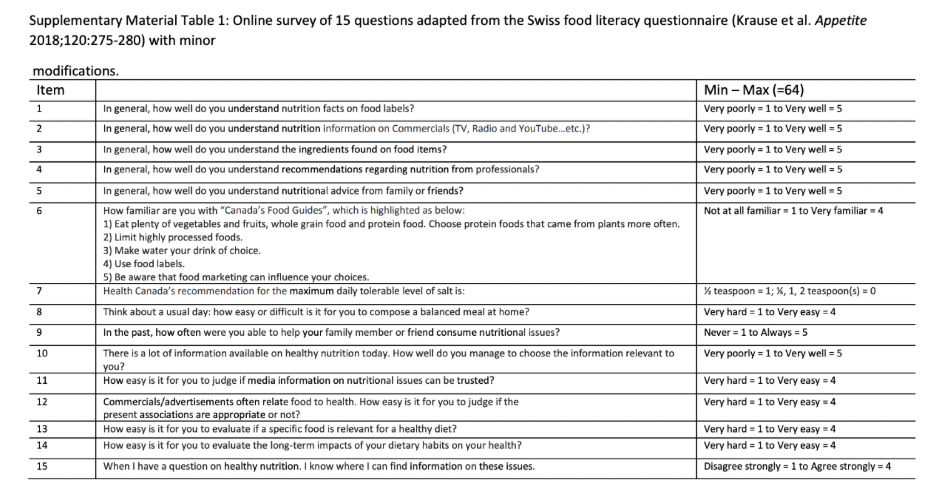
One online survey (Table 1), inspired by the Swiss food literacy questionnaire [3] and built with minor modifications to suit the Canadian culture was developed in English and French, the two official languages of New Brunswick, Canada. The survey comprised of 15 questions, mostly based on evaluating the user’s self-comfort and knowledge on food literacy, one question was taken from Canada’s Food Guide [4] and asked the daily salt recommendation for Canadians. The 15 questions have multiple choice answers that when added together could result in a maximum score of 64 points. The choices range from points 1-5, with 1 being the lowest score, and 4 or 5 the highest score. For example, question 1 asks: In general, how well do you understand nutrition facts on food labels? The answers range from Very Poorly (1 point) to Very Well (5 points). The survey was distributed to three schools across the Fredericton area: École Sainte-Anne, Fredericton High School, and Leo Hayes High School, through anonymous online submission using QR codes on poster invitations from December 2022 to March 2023. 225 completed surveys were collected. SPSS (Statistical Package for the Social Sciences) v. 27, was used to help with statistical analysis of the results to test for statistical significance and difference among compared groups. Ethnicity (Anglophone and Francophone), Sex (female or male), and grade level 9-12 were compared. Student t-test and one-way ANOVA (analysis of variance) were used for quantitative data between 2 groups and more than 2 groups respectively. A chi-square test was used for analysing percentage data. p values smaller than 0.05 were considered statically significant.
RESULTS
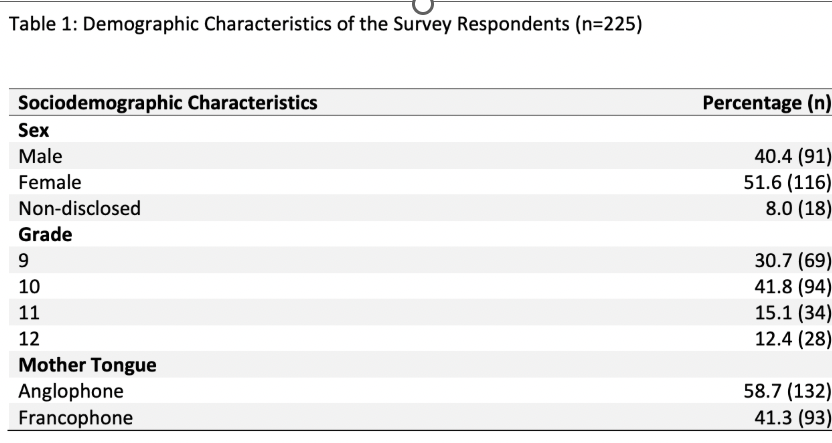
The average total score of Francophone students (48±5.4, n=93) was significantly higher than that of Anglophone students (43±7.9, n=132, p=0.021). There was no significant difference between female students (42±6.8, n=116) vs. male students (42±7.5, n=91), p= 0.826. The average scores of grades 9 to 12 were – Grade 9 (42±7.7, n=69), Grade 10 (42±6.5, n=94), Grade 11 (40±7.5, n=34), Grade 12 (44.6±6.3, n=28), one-way ANOVA p= 0.094 (Figure 1).
The number of correct answers to Question #7, the daily salt intake recommended by Canada’s Food Guide, was analyzed. 38% of Anglophone students answered it correctly vs. and 33.3% of Francophone students (p=0.484). 44.6% Female and 34.9% male students answered it correctly (p=0.149). Comparing the nutritional knowledge of students in different grades, 50% of Grade 12 students answered it correct. Grade 9 to 11 scored 46%, 44%, and 32% respectively. There was no statistical significance among grades (p=0.525) (Figure 2).
Discussion
As shown in this study, food literacy in youth New Brunswickers is generally suboptimal. The average score of the whole survey was between 40-48 (65-75% of total) (Figure 1). This is similar but slightly higher than the average of 63.5% correct from a recent food and nutrition knowledge survey of grade 5-8 students in Ontario [5]. However, the current study is the first survey, to our knowledge, using the Swiss food literacy questionnaire in Canada, and it is the first youth survey in the province of New Brunswick. Although the difference is small (48±5.4% vs 43±7.9%), Francophone students showed statistically significant higher food literacy than Anglophone students, which may indicate ethnicity and culture impact in the bilingual province. Contrary to the previous study suggesting higher scores in female [5], we did not find significance between genders.
Whereas the other questions focus on personal opinions and reflections, Question #7 is an objective question with one correct answer. Generally, only one third of high students could answer the daily salt recommendations correctly (Figure 2). Better scores might be associated with higher grade/age, however, half of the students still answered incorrectly at grade 12. Statistically there is no significant difference among grades/ages (grade 9-12) for total scores and correct answers for Question #7 (Figure 1 and 2), although another recent brief survey suggests more students of 14-17 years have heard of Canada’s Food Guide than those of 10-13 years (88.4% vs 80.7%) [6]. The result for grade 11 was surprising, perhaps the grade 11 students did not read the questions correctly or they rushed through the survey. As the sample size for grade 11 students is n=34, a greater sample size would have helped with this unexpected finding.
Better food literacy may be associated with fruit and vegetable intake and healthier eating in children in Canada, Italy, Japan, and the US [7-10]. The suboptimal results of the first food literacy survey on New Brunswick high school students suggests that more education on food and nutrition is needed for youth to help combat against obesity levels and associated health diseases.
REFERENCES
Statistics Canada. 2016 and 2017. Canadian Community Health Survey. Ottawa. https://www150.statcan.gc.ca/n1/pub/11-627-m/11-627-m2018033-eng.htm. Accessed on March 12, 2023.
Hack S, Jessri M, L’Abbe MR. Nutritional quality of the food choices of Canadian Children. BMC Nutrition 2021; 7:16.
Krause CG, Beer-Borst S, Sommerhalder K, Hayoz S, Abel T. A short food literacy questionnaire (SFLQ) for adults: Findings from a Swiss validation study. Appetite 2018; 120:275-280
Canada’s Food Guide. https://food-guide.canada.ca/en. Accessed on March 12, 2023.
Colley P, Seabrook JA, Woodruff SJ, Gilliland J. Examining Elementary School Children's Knowledge about Food and Nutrition in Southwestern Ontario, Canada. Can J Diet Pract Res 2022;83(2):59-67.
Corkum A, Vanderlee L, White CM, Hammond D. Awareness of Canada’s Food Guide Among Canadian Youth. Can J Diet Pract Res 2023;84(1):49-53.
McEachern LW, Ismail MR, Seabrook JA, Gilliland JA. Fruit and Vegetable Intake Is Associated with Food Knowledge among Children Aged 9–14 Years in Southwestern Ontario, Canada. Children (Basel). 2022 Oct; 9(10): 1456.
Grosso G, Mistretta A, Turconi G, Cena H, Roggi C, Galvano F. Nutrition knowledge and other determinants of food intake and lifestyle habits in children and young adolescents living in a rural area of Sicily, South Italy. Public Health Nutr 2013;16:1827–1836.
Asakura K, Todoriki H, Sasaki S. Relationship between nutrition knowledge and dietary intake among primary school children in Japan: Combined effect of children’s and their guardians’ knowledge. J Epidemiol 2017;27:483–491.
Pirouznia M. The association between nutrition knowledge and eating behavior in male and female adolescents in the US. Int J Food Sci Nutr 2001;52:127–132.
Vera Y. Chen1, * and Iris Y. Chen2
1 Faculty of Science, University of New Brunswick, Fredericton, NB, Canada
2 Faculty of Management, University of New Brunswick, Fredericton, NB, Canada
Feature Researchers


Follow The ASRJ